
Design of 8-bit digital Comparator using MSI ICs
Introduction:
The outcome of comparison between two numbers takes any of the three possibilities: Either both the numbers A & B are equal (A = B), or number A is greater than number B (A > B) or number A is smaller than number B (A < B). Any byte consists of two nibbles (lower nibble and the upper nibble) i.e. 8 bits. To compare two – 8 bit numbers, the concept used is to compare the most significant bits (MSB’s) of the two numbers and proceed with the next bit.
IC 7485 Based 8 bit Comparator:
IC 7485 is a 4-bit comparator with two – 4 bit inputs and three cascade inputs and three compare outputs, A < B, A = B and A > B. The cascade inputs enable cascading of multiple ICs 7485 to obtain N- magnitude comparator (N is an integer). To compare two 8-bit numbers two such ICs are required. IC 7485 can be expanded to compare more than 4 bit numbers. An 8-bit comparator compares the two 8-bit numbers by cascading of two 4-bit comparator ICs 7485.
Connection Diagram:
- For the lower order comparator IC 7485 (1), the A=B cascade input must be connected to Logic 1 (Vcc), while the other two cascade inputs must be connected to Logic 0 (ground).
- The lower order comparator outputs, A < B, A = B and A > B are connected to the respective cascade inputs of the higher order comparator IC 7485(2).
- The outputs of the higher order comparator become the final outputs of this eight-bit comparator. Fig.1 shows the connection diagram for 8 bit comparator using multiple 7485 ICs.
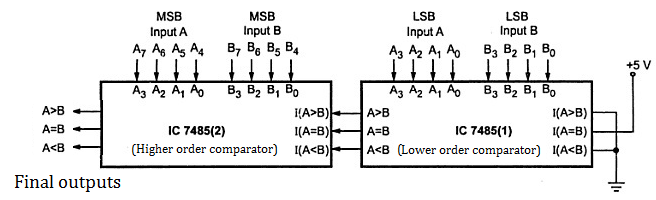
Fig 1. Eight bit Magnitude Comparator
Note:
8 bit Input A: A7 A6 A5 A4 A3 A2 A1 A0
8 bit Input B: B7 B6 B5 B4 B3 B2 B1 B0
Where A7 & B7 are the MSBs of binary numbers A & B respectively.
The Comparator compare the number bit by bit from MSB to LSB.
The function table of 8-bit comparator is:
| Comparing Input | Output | |||||||||
|---|---|---|---|---|---|---|---|---|---|---|
| A7,B7 | A6,B6 | A5,B5 | A4,B4 | A3,B3 | A2,B2 | A1,B1 | A0,B0 | A > B | A = B | A < B |
| A7 > B7 | X | X | X | X | X | X | X | 1 | 0 | 0 |
| A7< B7 | X | X | X | X | X | X | X | 0 | 0 | 1 |
| A3 = B7 | A6> B6 | X | X | X | X | X | X | 1 | 0 | 0 |
| A7= B7 | A6< B6 | X | X | X | X | X | X | 0 | 0 | 1 |
| A7= B7 | A6= B6 | A5> B5 | X | X | X | X | X | 1 | 0 | 0 |
| A7= B7 | A6= B6 | A5< B5 | X | X | X | X | X | 0 | 0 | 1 |
| A7= B7 | A6= B2 | A5= B5 | A4> B4 | X | X | X | X | 1 | 0 | 0 |
| A7= B7 | A6= B6 | A5= B5 | A4< B4 | X | X | X | X | 0 | 0 | 1 |
| A7= B7 | A6= B6 | A5= B5 | A4= B4 | A3> B3 | X | X | X | 1 | 0 | 0 |
| A7= B7 | A6= B6 | A5= B5 | A4= B4 | A3< B3 | X | X | X | 0 | 0 | 1 |
| A7= B7 | A6= B6 | A5= B5 | A4= B4 | A3= B3 | A2> B2 | X | X | 1 | 0 | 0 |
| A7= B7 | A6= B6 | A5= B5 | A4= B4 | A3= B3 | A2< B2 | X | X | 0 | 0 | 1 |
| A7= B7 | A6= B6 | A5= B5 | A4= B4 | A3= B3 | A2= B2 | A1> B1 | X | 1 | 0 | 0 |
| A7= B7 | A6= B6 | A5= B5 | A4= B4 | A3= B3 | A2= B2 | A1< B1 | X | 0 | 0 | 1 |
| A7= B7 | A6= B6 | A5= B5 | A4= B4 | A3= B3 | A2= B2 | A1= B1 | A0> B0 | 1 | 0 | 0 |
| A7= B7 | A6= B6 | A5= B5 | A4= B4 | A3= B3 | A2= B2 | A1= B1 | A0< B0 | 0 | 0 | 1 |
| A7= B7 | A6= B6 | A5= B5 | A4= B4 | A3= B3 | A2= B2 | A1= B1 | A0= B0 | 0 | 1 | 0 |
Example:
-
A = 0, B = 8
A = 0 (Decimal) 0000 0000 (Binary)
B = 8 (Decimal) 0000 1000 (Binary)
Ans:
A>B A=B A<B Low Low High
-
A = 64, B = 8
A = 64 (Decimal) 0100 0000 (Binary)
B = 8 (Decimal) 0000 1000 (Binary)
Ans:
A>B A=B A<B High Low Low
-
A = 96, B = 96
A = 96 (Decimal) 0110 0000 (Binary)
B = 96 (Decimal) 0110 0000 (Binary)
Ans:
A>B A=B A<B Low High Low
-
A = 30, B = 23
A = 30 (Decimal) 0001 1110 (Binary)
B = 23 (Decimal) 0001 10111 (Binary)
Ans:
A>B A=B A<B High Low Low
-
A = 42, B = 42
A = 42 (Decimal) 00101010 (Binary)
B = 42 (Decimal) 00101010 (Binary)
Ans:
A>B A=B A<B Low High Low